




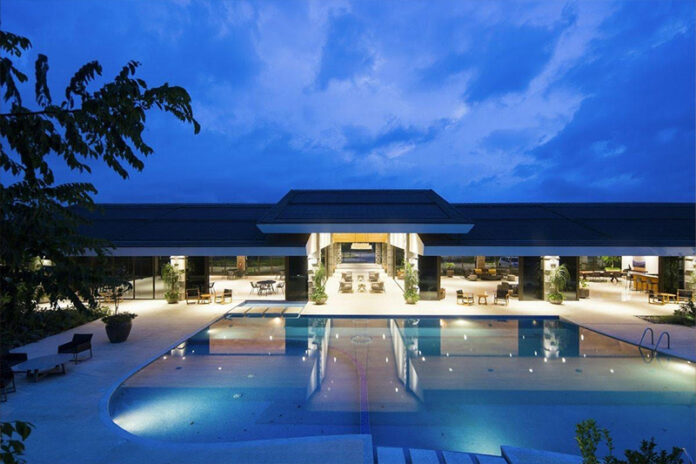
You arrive at Lanserhof Sylt the way you would arrive at a chapel — by reduction. The taxi from the Westerland airstrip pulls up to a low cedar building that looks like it was designed by someone who had been thinking, very hard, about silence. There is no welcome cocktail. There is no music. A woman in a linen uniform takes your bag and your phone, separately, with the same gentle ceremony.
“Sie können das Telefon abgeben, wenn Sie möchten,” she says. You may hand over the phone, if you wish.
You wish.
This is the second-most-expensive medical hotel in Europe, and arguably the most rigorous. I came because I had heard, from three different sources in three different cities, that Lanserhof Sylt is where the women who run things go when they break. A German publisher. The wife of a Greek shipping heir. A Vienna-based oncologist who treats herself, twice a year, with the seriousness she would treat a patient.

The intake is medical, not hospitable. On the first morning, a doctor named Dr. Köhler maps my microbiome, my heart rate variability, my fasting glucose, my cortisol curve, and the stiffness of my arteries — a number called pulse wave velocity that, until that morning, I did not know I had. He does not flatter me. He tells me my biological age is roughly two years over my chronological one, which is not a disaster but is not a triumph either, and he writes me a five-day plan.
The plan, in summary: do less.
Eat very little, and only what they bring you. Walk twice a day, on the path that runs along the dune. Sleep without an alarm. Submit to the daily liver compress (a hot, slightly aggressive bag of herbs strapped to the right side of your abdomen for forty minutes while a Bavarian-accented woman tells you to breathe). Drink the bitter tea. Sit in the sauna at 4pm. Be in bed by 9.

By day three, something happens that I have not been able to describe to my friends since. Time goes wide. The morning becomes a country with its own weather. I notice, walking the dune path at 6am, that the wind smells of salt and gorse and something faintly mineral, and I have the distinct sensation that I have not noticed the smell of anything in months.
The other women I see at meals — and we do not speak; the dining room is silent by design — all have the same look by day three. A face that is doing less. The shoulders coming down. The strange, slightly stunned quality of someone who has stopped performing.
On the fourth day, I have the consultation with the longevity team. A different doctor, an Australian named Dr. Whyte who used to run a sports medicine practice in Sydney, sits with me for ninety minutes. He goes through everything: my sleep, my training, my drinking, my supplementation, my relationship to ambition. He writes a protocol for the next six months: a peptide course, a specific magnesium, a creatine dose, a non-negotiable 10pm lights-out. He warns me, kindly, that the protocol will not work if I do not change what I do in the evenings.
“You are sleeping,” he says. “You are not resting. There is a difference.”
I leave Sylt on a Friday morning. The woman in linen returns the phone. There are 1,400 unread messages. I look at the screen for a long time on the ferry, and I have the curious experience of not wanting it. Not in a virtuous way. In a physical way, the way you do not want a third glass of wine when you are already full.
This is what they sell at Lanserhof, I think, watching the dune retreat behind the boat. Not the protocols. Not the doctors. The protocols are good and the doctors are very good, but the real product is the recalibration of what you experience as enough.
The bill, when it comes, is in four figures per night.
It is, by some distance, the best money I have ever spent.
The Viva File · Lanserhof Sylt
Location: North Sea island, 50 minutes by plane from Hamburg
Stay: 5–14 nights, doctor-supervised
Best for: Burnout repair, metabolic reset, sleep reconstruction
Don’t expect: Wifi in the rooms, alcohol, a phone signal at meals
Cost: From €1,400 per night, all-inclusive of medical
Book: Six to nine months ahead; Q1 has a waitlist
FAQ
What is Lanserhof Sylt?
Lanserhof Sylt is a luxury medical wellness retreat in Germany focused on longevity, metabolic health, sleep optimisation, burnout recovery, and preventative medicine.
Why is Lanserhof Sylt famous?
Lanserhof Sylt is known for combining advanced medical diagnostics with luxury wellness hospitality, attracting high-performing executives, entrepreneurs, celebrities, and global elites seeking nervous system recovery and longevity support.
How much does Lanserhof Sylt cost?
Stays at Lanserhof Sylt typically begin around €1,400 per night and include medical consultations, diagnostics, treatments, nutrition plans, and wellness protocols.
What treatments are offered at Lanserhof Sylt?
The retreat offers microbiome testing, cardiovascular diagnostics, sleep optimisation, metabolic assessments, hydrotherapy, fasting protocols, physiotherapy, sauna therapy, and personalised longevity plans.
Is Lanserhof Sylt a spa or a medical clinic?
Lanserhof Sylt operates more like a luxury preventative medical clinic than a traditional spa, combining evidence-based medicine with wellness and recovery protocols.